
For U.S. Latinos, the importance and meaning of identity are closely tied to how far they are from their family’s immigrant experience. Latinos born outside the United States (immigrants) are more likely than U.S.-born Latinos to say their Latino identity is central to who they are and to identify with their home country or ancestral heritage. Meanwhile, U.S.-born Latinos are more likely to emphasize their American identity.
These patterns hold across immigrant generations. Compared with Latino immigrants, second-generation Latinos (U.S. born to at least one immigrant parent) and third- or higher-generation Latinos (U.S. born to U.S.-born parents) are less likely to say their Latino identity is central to who they are, and more likely to describe themselves as American.
Still, majorities of both U.S.-born and immigrant Hispanics say that what happens to other Hispanics in the U.S. affects what happens in their own lives.
These findings come from Pew Research Center’s 2025 National Survey of Latinos, conducted Oct. 6-16, 2025, in English and Spanish among 4,923 Hispanic adults. At the time of the survey, about 42% of Hispanic adults were immigrants, 31% were second-generation Hispanics, and 24% were third- or higher-generation.
The survey was fielded as the Trump administration expanded immigration enforcement, including detaining or deporting large numbers of unauthorized Hispanic immigrants. An earlier report from the same survey found that Hispanic immigrants are more likely than U.S.-born Hispanics to express concern about their place in the U.S. and about deportations.
The U.S. Hispanic population has nearly doubled over the past two decades, from 35.3 million in 2000 to about 68 million people in 2024. Hispanics accounted for more than half of the nation’s population growth during that period, with immigration playing a major role.
This analysis is part of a larger study about U.S. Latino identity. For a summary of the main findings, visit “U.S. Hispanics are divided on whether their identity helps or hurts them in America.”
Hispanic immigrants are more likely than U.S.-born Hispanics to say being Hispanic is important to their identity
Most Latino immigrants (71%) consider being Latino extremely or very important to how they think about themselves. By contrast, fewer second-generation Latinos (57%) and those of third or higher generations (51%) feel that way. Despite these differences across immigrant generations, half or more in each group say their Latino identity is important to how they see themselves.
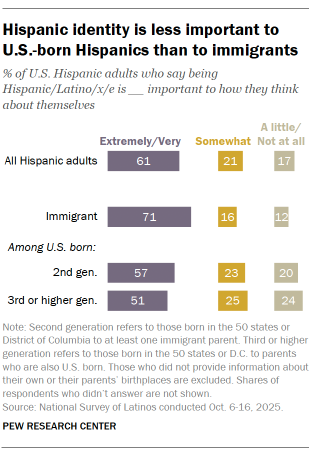
In addition, 70% of Hispanic immigrants consider their country of origin or heritage extremely or very important to how they think about themselves, a higher share than among Hispanics in the second and third or higher generations (57% and 47%, respectively).
Even as the importance of Hispanic identity declines across immigrant generations, majorities of Hispanic immigrants and U.S.-born Hispanics say that what happens to other Hispanics in the U.S. affects what happens to them personally. About two-thirds of immigrants (65%) say this, as do 67% of second-generation Hispanics and 55% of third- or higher-generation Hispanics.
We also specifically asked respondents whether they think that what happens to Latino immigrants affects their own lives. A majority of Latino immigrants (57%) say that what happens to Latino immigrants who live in the country legally affects their own lives a great deal or fair amount. And 64% of Latino immigrants say the same when it comes to what happens to Latino immigrants who live in the country illegally. Among Latinos born in the U.S., views are more divided. Roughly half of Latinos born in the U.S. say their lives are linked to the lives of Latino immigrants, whether those immigrants are in the country legally (47%) or illegally (51%).8
Regardless of how far respondents are from their family’s immigrant experience, relatively small shares feel responsible for other Hispanics. The same share of Hispanic immigrants and second-generation Hispanics (38% each) say they feel a responsibility to look out for other Hispanics extremely or very often, while 29% of third- or higher-generation Hispanics say the same.
U.S.-born Hispanics and Hispanic immigrants have similar views about how their identity shapes their ability to get ahead in the U.S.
- 24% of Hispanic immigrants say being Hispanic helps their ability to get ahead a lot or a little, as do 29% of U.S.-born Hispanics.
- 36% of Hispanic immigrants and 31% of U.S.-born Hispanics say being Hispanic hurts their ability to get ahead a lot or a little.
- 40% of Hispanic immigrants and 39% of U.S.-born Hispanics say being Hispanic neither helps nor hurts their ability to get ahead.
Third-generation Latinos most likely to describe themselves as ‘American’
Hispanics use many labels to describe their identity. These range from labels that refer to country of origin or heritage (e.g., Mexican or Mexican American) to pan-ethnic labels (e.g., Latino or Hispanic American), to American.
Despite widespread use of all these labels, some are used more often than others – and there are different patterns across immigrant generations.
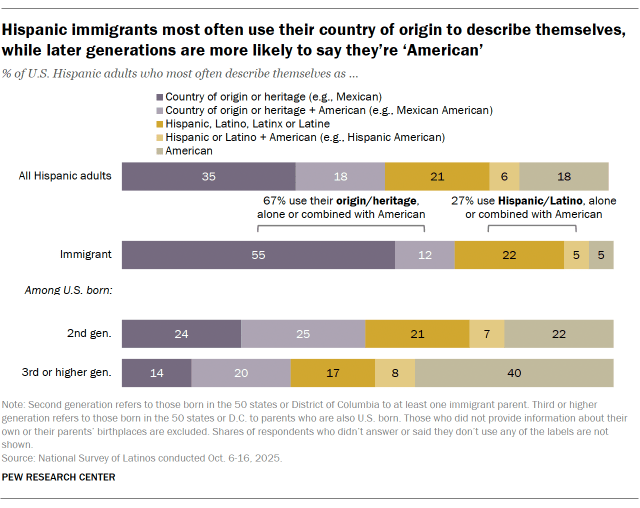
For example, 5% of Latino immigrants say they most often refer to themselves as American alone, compared with 22% of second-generation Latinos and 40% of third-or higher-generation Latinos who do the same.
The pattern is reversed when it comes to labels that include one’s country of origin or heritage (either on its own or combined with American). While 67% of Latino immigrants say they most often use these kinds of labels, smaller shares of second-generation (49%) and third- or higher-generation (34%) Latinos say so.
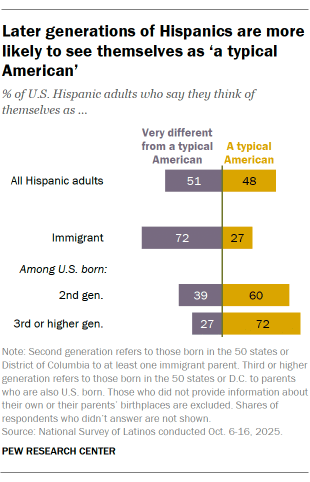
We also asked Hispanic adults whether they consider themselves “a typical American” or “very different from a typical American.” Just as with identity terms, there is a clear pattern across immigrant generations:
- 27% of Hispanic immigrants consider themselves a typical American, a share that rises to 60% among second-generation Hispanics and 72% among third- or higher-generation Hispanics.
- On the other hand, 72% of Hispanic immigrants say they are very different from a typical American. This share falls to 39% among second-generation Hispanics and 27% among third- or higher-generation Hispanics.
How Hispanic self-identification changes across immigrant generations
The findings in this story describe differences among U.S. adults who self-identify as Hispanic. However, not all U.S. adults with roots in Latin America or Spain self-identify as Hispanic.
The closer they are to their immigrant roots, the more likely adults with Hispanic ancestry are to self-identify as Hispanic, according to Pew Research Center estimates published in 2017.
In that study, the vast majority of immigrants and second-generation adults with Hispanic ancestry self-identified as Hispanic (97% and 92%, respectively). Fewer adults in the third generation or fourth and higher generations did so (77% and 50%, respectively).


