

For most Hispanics living in the United States, their Hispanic identity is an important part of how they see themselves. But there is no single view of what that identity means for their lives: some people see it as a source of connection or advantage, while others associate it with obstacles to getting ahead.
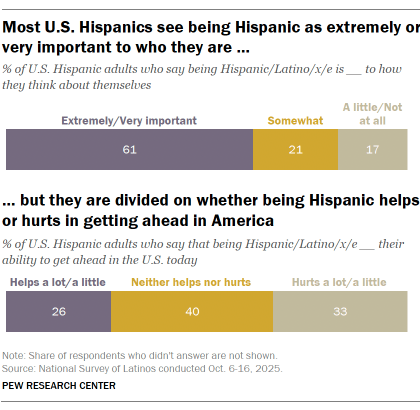
In a Pew Research Center survey conducted in October 2025, 61% of Hispanic adults say being Hispanic is an extremely or very important part of how they think about themselves. At the same time, 33% say being Hispanic hurts their ability to get ahead a lot or a little, while 26% say it helps a lot or a little and 40% say it makes no difference.1
Hispanics’ views about their identity differ sharply across two factors: political leaning and immigrant generation.
- Hispanic Democrats and Republicans often express different views about the importance and impact of their Hispanic identity. The gaps between Hispanics who voted for Democratic candidate Kamala Harris in 2024 and those who voted for President Donald Trump are often even more pronounced.
- Differences also emerge between immigrants and U.S.-born Hispanics, including those in the second generation and third or higher generations. (Find our definitions of immigrant generations in Key Terms.)
Hispanics see links between their identity and their lives in other ways. About a third (34%) say they personally experienced discrimination or were treated unfairly in the 12 months before the survey because of their Hispanic background by someone who is not Hispanic. A quarter or more say they were criticized for speaking Spanish in public (29%), told to go back to their home country (26%) or called offensive names for being Hispanic (25%).
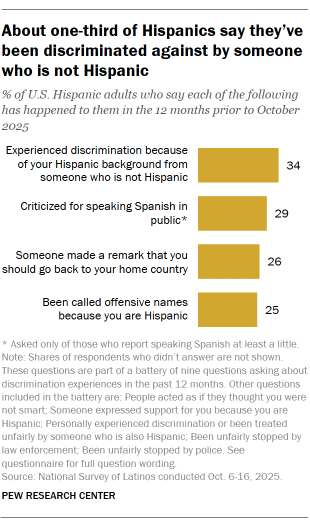
But not all Hispanic adults experience these types of discrimination. A majority (54%) say they have not experienced any of the four discrimination incidents related to being Hispanic asked about in the survey.2 And about a third (34%) say that someone expressed support for them because they are Hispanic.
These findings are based on the Center’s National Survey of Latinos, conducted Oct. 6-16, 2025, among 4,923 Latino adults in English and Spanish. The survey took place before subsequent changes in immigration enforcement and shifts in the national economic situation, which may shape how U.S. Hispanics experience identity and opportunity today. Other findings from the same survey – including those about Hispanics’ views of the Trump administration, immigration policy and economics – were published in November 2025.
Hispanics are the second-largest racial or ethnic group in the U.S., accounting for about one-in-five people in the country. They are a growing share of the U.S. population, electorate and labor force.
U.S. Hispanics have family roots across Latin America and elsewhere, and they emphasize their cultural diversity: About three-quarters say Hispanics in the U.S. have many different cultures, while a quarter say they share a common culture, according to the October survey.
This analysis examines how Hispanics view their identity and its impact on their lives in the U.S. It does so across political lines and immigrant generations. It also explores the labels that Hispanics use to describe their Hispanic and American identities.
The rest of this section summarizes some of the key findings on these topics.
Political identity is tied to how Hispanics understand and experience Hispanic identity
Like Republicans and Democrats overall, Hispanic partisans disagree on issues ranging from the economy to immigration. Hispanics also see the impact of their Hispanic identity very differently depending on their 2024 presidential vote and their party affiliation, according to the October survey.
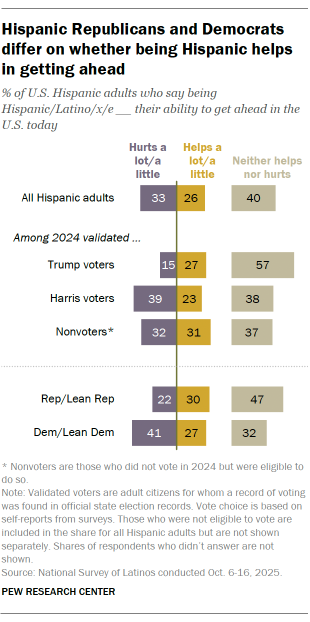
A majority of 2024 Hispanic Trump voters (57%) say being Hispanic neither helps nor hurts them get ahead in America. Much smaller shares say it helps a lot or a little (27%) or that it hurts a lot or a little (15%). By contrast, Hispanic Harris voters are more likely to see being Hispanic as a disadvantage: 39% say their identity hurts them, another 38% say it neither helps nor hurts, and 23% say it helps.
Political differences extend beyond perceptions of opportunity. Hispanic Trump and Harris voters also differ in how central Hispanic identity is to how they think about themselves and how connected they feel to other Hispanics. For example, 42% of Trump voters say being Hispanic is extremely or very important to how they see themselves, while 69% of Harris voters say the same.
There are similar differences by political party, though they are generally not as sharp.
Among Hispanic Republicans, nearly half (47%) say being Hispanic neither helps nor hurts their ability to get ahead in the U.S. This is a larger share than those who say it hurts (30%) or that it helps (22%).
By contrast, Hispanic Democrats most commonly say being Hispanic hurts their ability to get ahead (41%), while fewer say it doesn’t make a difference (32%) or that it helps (27%).
Political differences also extend to responses that people give about their experiences with discrimination. For example, Hispanic Democrats are more likely than Hispanic Republicans to say they were discriminated against or were treated unfairly because of their Hispanic background by someone who is not Hispanic, in the 12 months before the October survey (40% vs. 29%).
Similarly, Hispanic Democrats are more likely than Hispanic Republicans to say they were criticized for speaking Spanish in public (33% vs. 25%), that someone told them to go back to their home country (30% vs. 22%), or that they were called offensive names because they are Hispanic (29% vs. 22%).
Although many Hispanic Trump voters identify as Republicans, the two groups are not identical, according to a Pew Research Center analysis of validated voters. That distinction is reflected in some of the October survey’s findings.
In the 2024 presidential election, nearly half of Hispanic voters backed President Trump, their highest level of support for a Republican candidate across the last three presidential elections.
Most of these differences across political groups hold even after accounting for age, gender, income, immigrant generation and other factors.3
Jump to our detailed analysis on Hispanic identity across party lines and vote choice.
Distance from their family’s immigration experience is linked with how Hispanics understand their identity
How close Hispanics are to their family’s immigration experience shapes how they view their Hispanic identity. For example, Hispanic immigrants are more likely than U.S.-born Hispanics to say their Hispanic identity is extremely or very important to how they see themselves (71% vs. 54%).
In addition, differences often extend across immigrant generations: 27% of Hispanic immigrants consider themselves “a typical American,” while 60% of second-generation and 72% of third- or higher-generation Hispanics say the same.
On the other hand, both Hispanic immigrants and U.S.-born Hispanics share a sense of connection to other Hispanics. About six-in-ten in both groups say what happens to Hispanics in the U.S. overall impacts what happens in their own lives a great deal or a fair amount (65% and 61%, respectively).
While the share of U.S. Hispanics who are immigrants has declined in recent decades, this group makes up about 42% of all Hispanic adults, according to estimates from the 2025 National Survey of Latinos. In the same survey, second-generation Hispanics – people born in the U.S. to at least one immigrant parent – account for 31% of Hispanic adults, while Hispanics who are third generation or higher represent 24%.4
Jump to our detailed analysis about how Hispanic immigrants and U.S.-born Hispanics view their Hispanic identity.
Hispanics use many labels to describe their identity
Hispanic identity in the U.S. is not expressed through a single label. Instead, Hispanics use a variety of labels to describe themselves, reflecting their diverse backgrounds. Among Hispanic adults:
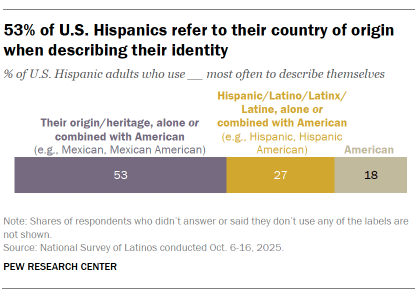
- 53% most often use a label that reflects their country of origin or heritage – either on its own or combined with American (e.g., Mexican or Mexican American).
- 27% most often use a pan-ethnic term – either alone or combined with American (e.g., Hispanic, Latino or Hispanic American).
- 18% most often describe themselves as American.
The labels Hispanics use most often also vary by political affiliation, 2024 vote choice and immigrant generation.
Hispanics who voted for Trump in 2024 and those of third or higher immigrant generations are the two groups most likely to say they use American on its own most often when describing their identity (43% and 40%, respectively).
By contrast, Hispanic Harris voters (54%) and Hispanic immigrants (67%) are more likely to most often describe themselves by their country of origin – either alone or combined with American.
Which pan-ethnic term do Hispanics prefer when referring to the Hispanic population?
Pew Research Center has frequently asked Hispanic adults which pan-ethnic term – Hispanic, Latino, Latinx or Latine – they prefer to describe people who are of Hispanic or Latino origin or descent.
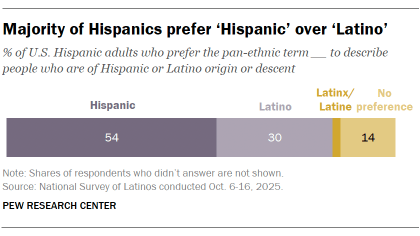
In line with previous studies, the October survey finds a majority of Hispanic adults say they prefer the term Hispanic (54%) over Latino (30%), while very few prefer Latinx (1%) or Latine (1%). Some 14% indicate no preference for any of these pan-ethnic terms.
Most groups, regardless of age, education, party affiliation and immigration background, prefer the pan-ethnic term Hispanic to Latino.
Jump to our detailed analysis about the different ways U.S. Hispanics express their identity.


